

Daffodils: A Miracle (Part 1)
Cosmic Connection Only

I do not plan adventures. I never have. Some people build a trip the way they build a house, foundation first, permits in order, every room accounted for before the first brick goes down. I have never done that. I land somewhere and let the place decide what happens to me, the way a leaf does not choose the direction of the river, it only chooses to float, and lets the current handle the rest. Some people call this reckless. I call it outsourcing to a more competent department, one that has never once sent me the wrong invoice.
I believe in universal energy. Not as a phrase I say at parties to sound interesting, not a bumper sticker philosophy I forget by Monday. As an actual operating system I have run my whole life on, quietly, in the background, the way electricity runs a house nobody thinks about until it is gone. It has never once crashed on me. I know how that sounds. I am telling you anyway, because everything that follows only makes sense once you accept that premise the way I did that night, standing in Warsaw with zero data, zero language, and a strange, stubborn kind of total faith, the kind you cannot manufacture, only inherit or earn.
I landed with no plan. No Polish. No idea that almost nobody around me spoke English either, that entire city blocks would pass without a single word I recognized, as if the alphabet itself had quietly changed shape the moment I crossed into it. I was an exchange student headed to Wroclaw, a city I had seen only as a name on a university acceptance email, four syllables I could not even pronounce correctly, a place that existed to me only as an idea, not yet as gravity. I took a taxi from the airport to the train station, and that is where the adventure clocked in for its shift, punched its card, and got to work on me immediately.
I bought a ticket. I had no idea which platform led to Wroclaw. The signage was a maze that had never heard of English, arrows pointing at other arrows, numbers that led to more numbers, a whole architecture built for people who already knew the answer. I tried asking people. They wanted to help, genuinely, their faces doing all the work their language could not. Wanting to help and being able to help turned out to be two completely different skills, and nobody around me had both at once. So I stood there, luggage at my feet, in the middle of a station that did not care whether I found my train or not. Not panicked. Thrilled, actually. There is a specific flavor of alienation that feels less like fear and more like electricity, the sensation of being the only ungrounded wire in a very busy circuit, sparking quietly, hoping something eventually finds the current and gives it somewhere to go. I was enjoying the voltage.
Then a woman in her forties walked up to me, no warning, no preamble, and plucked the ticket straight out of my hand as if she had been sent specifically to retrieve it. She grabbed my other hand and pulled me toward a train door with the certainty of someone who has done this exact rescue a hundred times before and will do it a hundred times again. She pointed one finger. This one. I got in. The doors closed behind me almost the instant my feet cleared the gap, a margin so thin it barely counts as a margin at all. If I had missed that train, the rest of this story does not exist, there is no Wroclaw, no snow, no gate, nothing after this paragraph. She never told me her name. She did not have time to. She had a train to put a stranger on, and once that job was done, she simply turned and became part of the crowd again, mission complete, no applause requested.
Hours later I reached the connecting station. Nine in the evening. The kind of empty that makes you check your own pulse against the silence, the kind that makes you wonder if you have somehow slipped outside the timeline you started the day in and landed in a slower, quieter one running parallel to it. I sat on a bench near the platform with a small snack, in no hurry, enjoying the nothing, watching my own breath turn visible in the cold, when a train inspector approached me from a good distance away, moving with a purpose I did not yet understand. She looked at my ticket for less than two seconds, grabbed my luggage, and started running. I ran behind her, luggage bouncing against my knee, no explanation offered and none needed, the two of us sprinting through a station that had seemed, moments earlier, entirely abandoned. She threw my bag onto a train, got in behind it, sat me down like a mother settling a child who does not yet know he was in danger, and the train continued on toward Wroclaw as if none of that had been unusual, as if this was simply how the night intended to move me forward, one urgent stranger at a time. I reached at one in the morning.
Outside the station, the first snow of the year was falling. Soft, unbothered, landing on my shoulders like it had been expecting me for some time and was relieved I had finally shown up. I sat down on a bench in the open, under the sky, under the snow, with absolutely no idea what came next, no hostel address memorized, no language to ask for one, nothing but the quiet certainty that whatever had been steering me so far had no plans to stop now. This is normally the part where a person gets anxious, where the mind starts drafting worst case scenarios and reading them aloud on a loop. I did not. I was exactly where the universe had decided I should be, which is the only address I have ever fully trusted, the only one that has never once given me the wrong directions.
A girl walked up to my bench. Curly black hair, summer clothes, same as mine, same wrong season entirely, both of us dressed for a version of this trip that had clearly not been consulted about the weather. One look and I understood her completely, the way you understand a person standing in the same kind of water you are standing in. She had no idea what came next either. We said hello the way two people say hello when neither one has a map, when the not knowing itself becomes the only shared language available. We traded pieces of how we got there, small fragments of two separate chaoses that happened to intersect on the same cold bench. Crazy stranger, instant friend, the kind of friendship that forms fast because it has to, because there is no time to build it slowly, only enough time to lean on it immediately.
We found a taxi that belonged to someone else’s booking and got in anyway, two people borrowing a stranger’s ride the way you borrow an umbrella in a storm, without asking, because the rain does not wait for permission. The driver tried to pull us back out. Neither side understood a single word of the other’s protest, an entire argument conducted in tone alone. I showed him a map on my phone, the one universal language that still worked. He decided, for reasons I will never know, to let us stay. We dropped her at her address first, her half of the night folding closed behind her the way a chapter does, quietly, without ceremony. Then he turned around and asked me where I was going.
I had no answer. Not one. And that is exactly when the second miracle of the night arrived, because that is how the night had been operating from the very beginning, one impossible hand appearing exactly when the last one let go.
An Indian stranger, someone I had never met, someone who only knew me from a Facebook expat group, a name attached to a profile picture and nothing else, messaged me out of nowhere. Brother, I saw you are in Wroclaw. I cooked. Come to my place. I asked him why a person cooks dinner for someone he has never seen in his life. He said it was just a welcome, as if that explained everything, and somehow it did. I gave the driver the address. My phone died the second it left my hand, the battery choosing that exact moment to give up, as if its job had officially ended the instant the address was delivered.
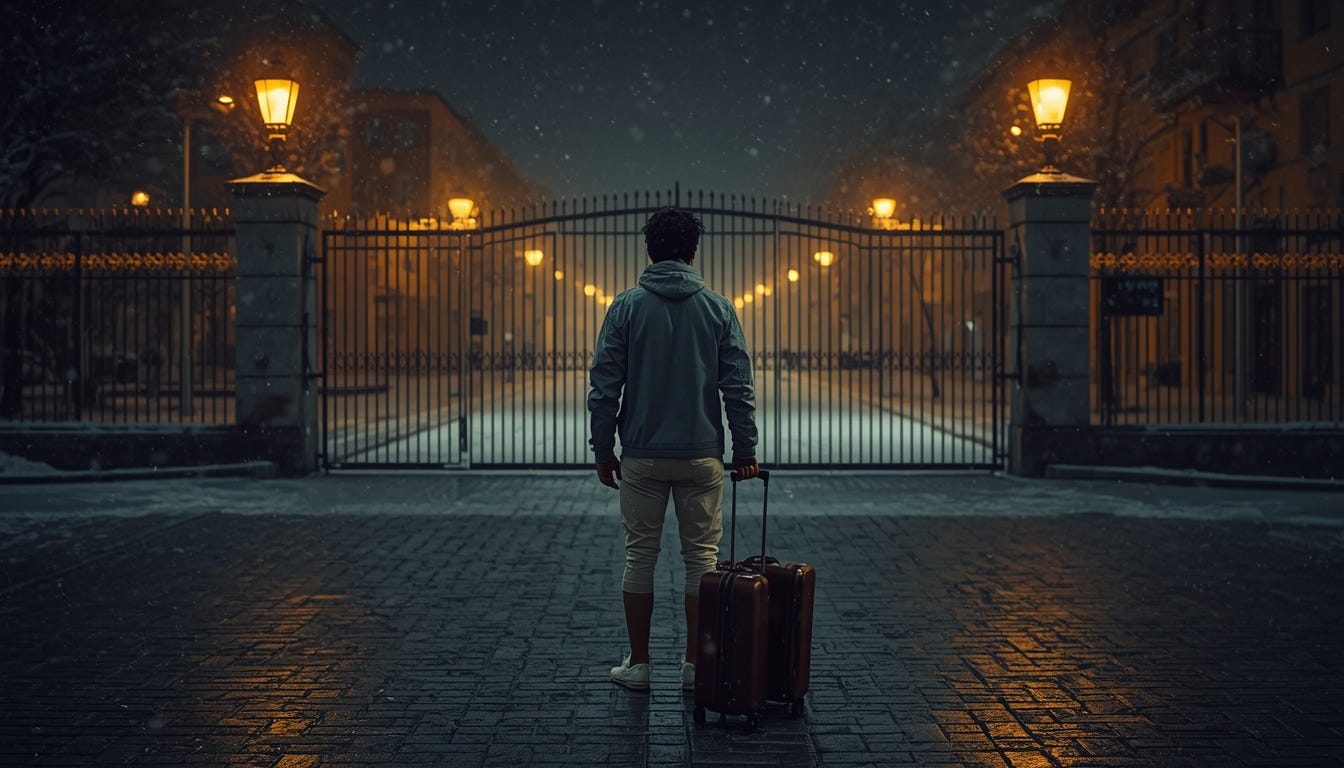
The driver found the location anyway. It was a private community, gated, closed, the kind of place designed specifically to keep strangers like me outside it. I had never asked for a house number. There was no way to call ahead, no way to knock on the right door, no phone to call it with even if I had somehow known which door was the correct one. The driver dropped my bag at the gate and drove off into the snow, tail lights shrinking into white until they disappeared entirely, and left me standing there.
Just me, the snow, and whatever it is that had been carrying me since Warsaw, still working, still quiet, still not finished. No signal, no number, no name to call out into the dark. Only the snow falling the way it had been falling all night, and only cosmic connection, still holding, still refusing to let go of a stranger it had decided, somewhere back in Warsaw, to see all the way home.
Tomorrow, the gate opens.
“Wanting to help and being able to help turned out to be two completely different skills.”
An excellent line!
This was wonderfully unsettling, Marco. The dream has that rare nightmare logic in which every image feels impossible yet somehow inevitable. The endless staircase, the ritual, and the frozen graveyard all carry a deep sense of dread without losing the thread of Marco’s inner struggle.
“You cannot outrun yourself” is the line that holds the whole passage together for me. It turns the horror inward. The real threat may not be the Black Church, the goddess, or even the neural implant, but whatever Marco has been trying to avoid within himself.
I also loved the contrast between the ancient imagery and the technological static waiting for him when he wakes. It leaves just enough doubt about whether this was merely a dream—or something reaching him through the implant. A haunting and beautifully controlled excerpt.