

Just God Things
Justice delayed is justice denied.

This happened, truly, in the southern part of India, a long time ago. One story out of a billion just like it, scattered across the world, mostly untold.
Somewhere there is a hard drive. Universe sized. Every keystroke you have ever made against reality, logged, timestamped, unerasable.
They used to call it the Akashic Records. Old word for an old ache. The belief that nothing done in the dark stays in the dark forever. Not even the things done inside a courtroom, where the dark wears a black coat and calls itself the law.
This is the story of a boy named Rama. Sit with it slowly. It took him fifty five years. It can take you five minutes.
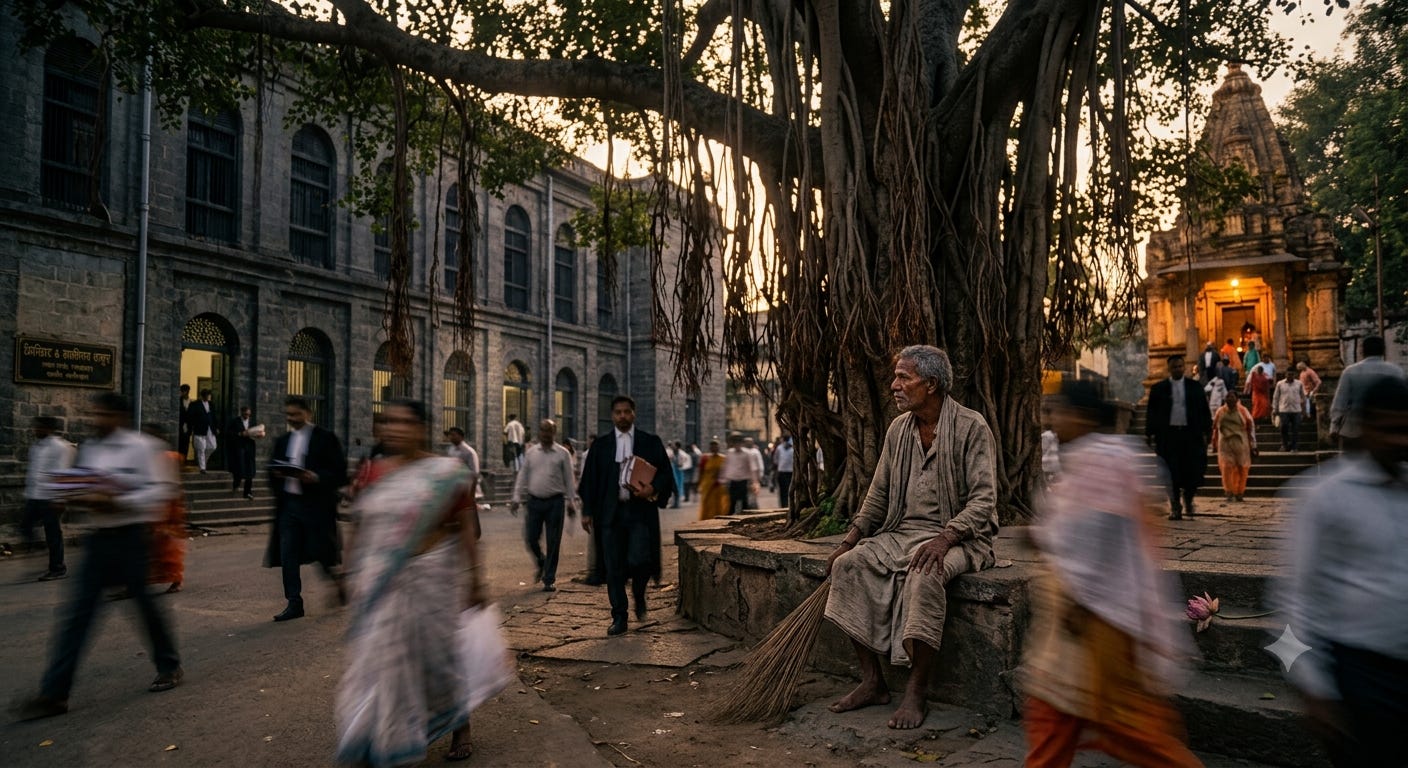
He was ten when the accident took his family whole. Mother, father, an entire bloodline, gone in one turn of a wheel on one ordinary road. He alone survived, and survival, it turned out, was the cruelest gift the day had to give. Because before the flowers on four graves had wilted, a local politician was already forging paper. A death certificate. For the boy who was still breathing, still crying, still asking someone, anyone, where his mother had gone.
On paper, Rama died with his family that day. Only the wealth survived, and it did not survive for him.
He went to court, because that is what a child taught to believe in fairness does. He asked, twelve, thirteen, fourteen years old, standing in front of men in robes, to simply say: I am alive, look at me, I am standing right here. The lawyers took the little he had. Then they took more. Then they learned that a case which never closes is a case that never stops paying, and so they made sure it never closed. The judges signed dates further and further into a future that kept moving away from him. Not villains, understand. Just men who found a comfortable rhythm and built careers inside it.
He lost the case. He lost the money. He lost his own name.
No death, no birth. A government that had buried him on paper would not issue him a single card to prove he was flesh. No ID, no ration, no vote, no job, no rented room, nothing that a living man is owed. So he stayed where the wound was made. He swept the floor of the court that erased him. He carried tea to the men who billed him into nothing. He wore the shirts strangers left behind and ate what strangers spared, and the children of that town, growing up around him, learned to call him the ghost. A boy walked into that courthouse at ten. Something quieter, something that had stopped expecting anything, walked its halls at sixty five.
Nobody who called him ghost ever asked him why. That is the quiet cruelty in how the world looks at a man sweeping a floor, or sleeping on a step, or wearing another man's old shirt. It assumes the ending without ever asking for the beginning. Every person you walk past without a second glance is carrying a full life behind their eyes, and some of those lives hold a scream loud enough to shake a courtroom, if anyone ever cared to listen for it.
There was a temple at the corner of the front street, just outside the court gates. Small, old, easy to miss unless you already knew what it held. The story around it was simple, the way the truest stories always are: bring the god one lotus, ask for the one thing you need, and somehow, someday, it arrives.
In fifty five years, Rama never once crossed that road.
What does a man who has been legally dead for half a century have to ask a god for. He had already asked the court. The court was supposed to be god's paperwork department, and it had failed him worse than any silence from the sky ever could.
Then one evening he was sitting where he always sat, under the old banyan tree inside the court complex, its roots older than every lie that had been told in the building behind him. From there, through the branches, he could see the temple steps. And on those steps, a father was on his knees, screaming at the sky the way only a man who has just buried his child can scream.
Rama knew that scream. He had never made it out loud, but he had lived inside it for fifty five years.
He asked someone nearby and heard the story. A daughter, dead, not from illness or accident, but from a court case dragged so long, drained so completely, that by the time judgement finally came, there was no life left worth judging for. Same rooms. Same robes. Same rhythm. A different name on the file, the same machine underneath.
Something in Rama, some part that had gone quiet decades ago, stood up that evening.
The next morning, for the first time in fifty five years, he bought one lotus. He crossed the road he had refused to cross since he was ten years old. He stood where the crying father had stood, and he did not scream. He simply asked. Not for money, not for the wealth that was taken, not even for his name back. He asked, the way the old tradition says you must, for the one thing he needed. Whatever that was, he kept between himself and the flower.
He did not know if anything was listening. That was the whole terror and the whole faith of it, standing there anyway.
Months passed the way they always do, indifferent to who is waiting on them.
Then it began. Small leaks first. A journalist who would not let go of one file. Then more files. Then the pattern, the same judges, the same lawyers, the same partnership of delay and profit, visible finally to anyone willing to look. It reached the papers. It reached the television. It reached parliament, where men who had never met Rama or the crying father said their names out loud, said the word corruption out loud, said enough is enough, in a chamber far from the banyan tree that had shaded a boy into old age.
The court was gutted and rebuilt from the inside. Judges removed. Lawyers disbarred. And in the chaos of that cleaning, someone finally did what fifty five years of paperwork had refused to do. They opened the old, dead files. The ones left to rot on purpose. Rama's among them.
One judge, one honest one, the kind that the old system had always managed to transfer away or wear down before, sat with a file that had a photograph of a ten year old boy and a sweeper in his sixties, and understood, in the way only a person still capable of shame can understand, exactly what had been done.
Rama got his name back with a single signature. Not the wealth, that had long since disappeared into other men's grandchildren's lives. Just his name. Just the plain, enormous fact of being allowed to exist on paper the same way he had always existed in flesh.
The moment the judgement was read out, the whole court complex broke into applause. Loud, long, echoing off walls that had heard fifty five years of his silence and never once clapped for him. Lawyers stood. Clerks stood. Strangers who had walked past him with a broom in his hand a thousand times without seeing him, stood and clapped like they had been rooting for him all along.
And then they shouted it. Rama. Rama. Rama. His own name, out loud, over and over, filling a courtyard that had not spoken it in fifty five years. The same mouths that had called him ghost to his face, day after day, because a man with no power to answer back is the safest man in the world to mock, that had taught their children to do the same, now shaped around his real name like it had always belonged to them to give.
Rama stood there too, in the same corner he always swept, and watched the same hands applaud him that had, for fifty five years, signed his delays, billed his silence, and called him the ghost right to his face, because he had no power left to make them stop. The hands had not changed. Only the story they were telling about themselves had.
He did not begrudge them the noise. He had learned long ago that people need to clap for justice at the end, even the ones who spent a lifetime denying it, because it lets them believe they were never truly part of the crime. He simply picked his broom back up when the clapping died down, because that was the only part of the day that still made sense to him.
Fifty five years. He never believed justice would cost him that much of a single life. Nobody should have to believe that and still be right.
Call it god if that word still means something to you. Call it cosmic energy, call it karma finally clearing its throat, call it nothing more than a journalist who happened to be stubborn on the right week. It does not matter which name you put on it. What matters is that it moved only after someone asked. A father screaming on temple steps. A boy, grown old, finally crossing a road he had avoided his whole life.
Maybe that is the whole secret hiding inside the phrase people throw around so lightly. Just God things. Maybe it was never about miracles falling out of the sky uninvited. Maybe it is about your neighbour, your god, your universe, your own two feet, only ever showing up once you have had the courage to ask. Out loud. On your knees, or standing, it does not matter which.
Justice delayed is justice denied. Everyone who has sat in a waiting room they did not choose already knows that line by heart.
Next time you pass a man sweeping a courtyard, a woman sleeping under a bridge, a face the world has already decided to look through, remember Rama. Remember that a ghost is rarely born a ghost. Someone builds it out of a living person, one denied paper at a time. Behind every scream you walk past without stopping, there may be a whole life you have not earned the right to judge yet.
This one is for them. For the billions of Ramas the world has not gotten around to naming. The unsung ones still sweeping the floors of the very systems that broke them, still tolerating, still waiting, still alive on the inside long after the paperwork gave up on them. May their names be shouted too, someday, by the same mouths that once looked away.
But somewhere, that hard drive kept humming through every one of those fifty five years, patient in the way only something eternal can afford to be. It did not forget Rama while the courts did. It did not forget the crying father either. It simply waited for the asking.
It is still recording. It is still waiting on yours.
This is for every man swept aside, every woman mistaken for less than she carries, every scream mistaken for madness by people too comfortable to ask what it means. For the billions of Ramas the world will never write a post about, still sweeping floors, still tolerating, still living inside injustices no headline will ever reach. You are not invisible. You were only unasked.
One story, out of a billion. This one just happened to be true.